Sunday, August 26, 2012

Living Overseas


Rota, Spain
At the age of 21 I hopped on a plane and flew to Rota, Spain to follow the guy I would eventually marry.  He was going to be stationed there with the US Navy for three years and had asked me to marry him just before he left 4 months earlier.  I arrived with two suitcases of clothes and some money from Dad in lieu of a wedding.  That was the beginning of a great adventure living in and getting to know a different culture and country. 

Arcos de la Frontera

The first two weeks were full of setting up our furnished apartment located on the third floor of a newer building that was only a mile or so from the main gate of Naval Station Rota.  We mostly shopped at the Navy Exchange at first but it was fun to walk around town and look at all the small stores with many different things.  After a few weeks the “new” wore off and the difficulties of living and functioning in a foreign culture became real.  Nothing in Spain happens at the speed that a young American is used to.  Very few people had home phones (cell phones were unknown back then), there were only a couple of local Spanish TV channels (Satellite TV did not exist), and many locals were quite impatient with my poor Spanish.  It took a while to realize that people were not being rude or lazy, it is just how their culture functions.  Plus they had spent many years dealing with rude Americans and it took time for them to figure out I was not like others.  Also, there was no 24 hour 7-11s to pick up some forgotten item at any time of day or night, that is such a small things but the small things can make a difference.  So much was different, I really felt like a fish out of water and I was often very lonely because my husband was always gone on deployment.   It helped me to appreciate living in the US and I decided then that I would encourage my children to travel one day. 
Cathedral in Cadiz
For the first few months I did not know anyone, I did not work and did not have a car, so I spent many days just walking around town. There was no map so I just walked where ever looked interesting and kept walking until something looked familiar.  Thankfully it was a small town with an ocean on one side and a military base on the other.  After I bought a car I followed that same pattern all around the surrounding towns and that is how I stumbled across some wonderfully beautiful old structures; churches, castles, museums, and government buildings.  Sometimes I could remember how to get back to those historical places and sometimes I just had to stumble across them again.   When I got a job at the Navy Exchange my exploration days were limited and I started to settle into daily life.  I got to know some of the local neighbors but still socialized mostly with the other Americans.  As I became more comfortable living on the Spanish economy I shopped for more and more items at the local stores.  Of course, the Navy Commissary was there for all the staples we were used to cooking and eating, but it was fun to roam around the local grocery store or Hypercore (Wal-Mart type store) and buy local products also. 
The Alhambra, Granada, Spain
I met many Americans stationed in Rota who lived on base and almost never left the base.  I always wondered how they could do that without going stir crazy.  I also met people who did nothing but complain about the Spanish people or the differences in culture and lifestyle.  Those people had a tendency to think that different meant bad and they were miserable the whole time.  I wonder if they look back today and regret missing seeing as much as they could while they were there.
Cathedral, Jerez de la Frontera, Spain
I hated history as a kid in school, it seemed so boring, but I loved seeing all the historical places in Spain.  It brought those boring words in a book to life when you could see the actual place something historical happened.  Christopher Columbus actually walked the streets of Seville and he is allegedly buried at the cathedral.  Cadiz was the oldest continually inhabited city in all of southwestern Europe, supposedly first settled about 1000 BC.  Jerez de la Frontiera has some of the best sherry vineyards and bodegas in the world.  I became the unofficial tour guide.  I loved to take visiting guests or new Navy friends to see all the old forts, castles and cathedrals.  Thankfully my husband and friends also like to explore the area also.  We spent many weekends driving around Southern Spain exploring small towns like Rhonda, Arcos, Ubrique, and Gibraltar. 
Cathedral, Sevilla, Spain
Over time, my Spanish got better and I became more comfortable and came to really enjoy the slower paced life of Southern Spain.  Two and a half years later we received orders to Adak, Alaska.  I was excited about getting to experience a completely new place but sad to leave Spain.  I had become very comfortable living, working, and shopping in the Spanish culture.  I felt like I was leaving my home. 
The experience of living in Spain when I was so young really left a deep impact on me.  I still crave good Spanish cheese, huge olives stuffed with garlic, crusty Spanish bread and cheap red wine mixed with La Casera.  To this day, I try to find that same “cultural experience” when I travel somewhere, but it is almost impossible to really get to know a place in two weeks or less.  Now look forward to the time when I can once again live somewhere with a similar culture; Belize, Mexico, the Caribbean.   It also branded a love of travel on my heart; a love that has only grown over time and has lasted much longer than my marriage. 
TRAVEL ON!

Tuesday, August 14, 2012

The Travel Addiction

I have discovered that travel can become a full blown addiction, not much different than any other substance addiction.  Oh it starts so harmless, a quick trip into Canada or Mexico, just across the border for the day.  It is interesting; it is even a bit exotic.  That leads to a trip across the pond, maybe some place relatively comfortable like England; why not, they speak a somewhat understandable version of English.  You are fascinated by soaring spires and the colorful stain glass of old churches.  It is fun to visit places that are full of the ghosts of history such as the Tower of London, see buildings that are over 1000 years old, and imagine you just saw Queen Elizabeth peek out the window of Buckingham Palace.

That trip was a bit expensive so you tell yourself that you must stay home for a while.  Then you are invited to visit friends who live in Greece.  Why not, it’s not really like traveling alone; there are people to meet you on the other side.  The amount of history in Athens is completely overwhelming, your body is exhausted from walking and your mind is exhausted from trying to understand what you are seeing.  Then the beauty and the serenity of the islands is the exact opposite of Athens.  After staying home for a few years, as your 40th birthday approaches, you decide to jump right into the deep end of the travel ocean and book a safari to Tanzania. 
Then you are invited to go scuba diving in the Cayman Islands with a group of complete strangers.  After that, it is a free for all of unabashed travel to any location; all around the Caribbean, the South Pacific, Iceland, Peru, and China.  Any place you can find an excuse to go.  Three or four times a year, work be dammed, you have to go.  Money be dammed, you can’t take it with you.  If you don’t have a travel itinerary on your desk for the next trip or two you feel restless, bored.  You spend your spare time searching for excuses to go somewhere and then planning and researching.  You get more and more bold and the destinations just get more exotic.  Finally you end up sleeping in a tent at Everest Base Camp the night before you cross the border from Tibet to Nepal.  The same girl who was a bit timid on her first trip to Mexico is now catching a bus to Kathmandu.  It sneaks up on you and it all happens so quickly, so innocently. 
My advice?  Embrace the addiction; ignore the friends who roll their eyes when they hear where you are going next.  Go anyplace you find interesting, just do it! 
TRAVEL ON!

Sunday, August 12, 2012

Are you a traveler??

Let’s face it, some people are travelers and some are not.  If you are not sure what I mean, then most likely you are not a traveler.  Those of you out there who have traveled with any regularity know exactly what I mean.  A traveler is really good at just going with the flow.  Plane delays, cancelations, bad weather, gross food, dirty hotel rooms, rude locals, locals who are too friendly and even being completely lost won’t ruffle a good traveler, most of the time!  It’s all part of the adventure and complaining or getting angry won’t change things.  It just makes you and your travel buddy miserable.  Look for a solution, chill out and go with it. 

Dinner for orphan boys in Moshi, Tanzania
You never know if the person you choose to travel with is going to be a good travel companion until you actually get out there and then it’s too late.  When choosing a travel companion there are some red flags that will help you determine if your buddy is a traveler before you hit the road.  Do they complain about the food served to them in the states?  If so, they will never be content with food served in many parts of the world.  There are some wonderful, exotic destinations of the world where the food is strange, slimy, smelly, too strong or even tasteless.  A traveler smiles and says a polite thank you when served something unrecognizable, then at least tastes it.  Never ask what it is until AFTER you have tried it.  The wonderful tender, tasty meat you are really enjoying might not taste so well once you learn its donkey.  BTW, donkey is actually really good and very tender; they are raised for meat in China.  From there you keep smiling and then eat what you think you can stomach, or eat just a small bit and then claim you are stuffed full!!  Later, that granola bar in your suitcase will be the best tasting granola bar you ever ate.
"Fancy" Squatty Potty
Does your potential travel companion carry around an enormous purse with more stuff than they can use in a lifetime?  Do they take three bags just for a weekend get-a-way?  If so, you may find they arrive with more luggage than they can carry as they run through a train station.  My cardinal rule:  don’t take more than you can carry easily all by yourself.  It can be really hard to do, especially if you are gone more than a week or two.  I am still working on downsizing my wardrobe for a two week trip.  My goal is to get it down to one medium back pack but I am not there yet.  I still have a roller bag and small backpack.

Notice how your travel buddy acts when meeting people of different ethnicities who live in the states.  Are they uncomfortable, do they complain about the differences in accent or smell? Or do they find other cultures interesting?  Being willing to embrace another culture and respect their daily lives and habits is paramount when traveling.  It can be hard, especially in places where there is little personal hygiene or no such thing as personal space and where there is no such thing as a line.  As an American, it is so difficult for me when I have to accept the pushing and shoving of the locals just to get to security or through an open door to some event.  
Street Vendor Xi'an China
We will all make cultural faux pas when traveling so don’t fear it, embrace it and be as respectful as possible.  Whoever coined the phrase, “When in Rome do as the Romans do” was clearly a traveler!  To me, exploring different cultures, different landscapes, different food, different daily habits, and different lifestyles is fascinating.  It helps me to appreciate my life here in the US but also keeps life interesting.  

TRAVEL ON!!

Saturday, June 16, 2012

China: Communism with a side of Capitalism

I am told China is a communist country…really?  The tourist wouldn’t know that by the look of things.  Capitalism is rampant and in the cities you will find a large and very wealthy population.  Many are educated at Ivy League Universities in the US and now run private multi-national companies in China.  Yes many of them are members of the Communist Party; it’s the smart thing for a wealthy business man to do in a Communist run country.  The only real vestige of communism I saw was the name of the party and the fact that all land is owned by the government.
Before my first visit to a Communist country, my mind’s eye envisioned oppressed people standing in bread lines, living very poorly in a rural tin roof shacks or dirty dilapidated city high-rises.  State owned companies, hotels and stores that are gray, uninteresting box shaped buildings with workers who are dressed in gray and could care less about their job.  I expected to see order on the streets with government police telling people where to go and how to behave.  Boy was I wrong!!
While I did see a lot of poverty, I saw many more vibrant, happy, healthy and very wealthy people.  They were decked out in the latest fashion brands and driving very expensive automobiles.   I saw many privately owned businesses from large fancy hotels all the way to small grocery stores run by one old woman.   There was no way for the tourist to tell the difference between a government owned business and a private business.  Order did not exist; chaos was the name of the game on the streets, in the airport, in stores and in restaurants.  There is no way to keep order when you have more than 1.3 billion people. 
As we drove through the country along the very nice but almost empty interstate highway system I saw a lot of farming villages.  Since the government owns all the land they designate where the farmer can farm.  The average farmer is given about an acre of land and uses it mostly for subsistence but will sell some produce and is able to earn about $200 per year.  The government also tells that farmer and all surrounding farmers where they can live so the farmers don’t live where they farm.  They congregate into small villages with townhouse style homes.  So the countryside was dotted with these villages.  I never saw any large farming operations but, of course, I only saw a small part of the country. 
Real estate development in the cities was everywhere; there is a joke about the crane used to build high-rises being the national bird of China.  You would think building a multi-million dollar high-rise on government owned land would be too much risk for developers but that was not the case.  I am told that most buildings are sold out before they are complete.  Oddly I saw many high-rise condos that looked mostly vacant; in the evening they would be almost completely dark and was told that was because they were purchased by speculators who were sitting on them in order to sell later.  Can you say, “Real Estate Bubble?”  In the 60’s the government started leasing the land to developers with a 70 year lease and no one knows what will happen when that lease is up. 
Something we are hearing about a lot in the news today is the one child policy.  Based upon our guides and US friends who live in China I am told that enforcement of rules varies by location.  With such a large country it is almost impossible for the federal government to monitor anything.  The local district and province leaders are the ones with the real power so they decide what laws are enforced and how.  In Shanghai couples who are both only children are allowed to have two children.  If you have a second child when you are not supposed to then you just pay a fine to the government.  No one in the city talks about forced abortions or forced sterilization.  Of course, it is also a problem they don’t want to talk about with tourists. 
One of 4 Museum Buildings, Terra Cotta Warrior Museum
The places we went that were obviously government run, such as the Three Gorges Dam and the Terra Cotta Warriors Museum, were extravagantly built.  Very fancy buildings, large visitor centers, beautiful gardens, decorative fountains, koi ponds, even escalators instead of stairs, plus wide and very new asphalt highways leading to them were all standard items.  The highway system had frequent toll booths and large, mostly empty, gas station/convenience stores spaced almost as often as the toll booths which were all quite overbuilt for the low number of users.  Where else can you buy pre-packaged chicken feet and Chinese beer for the road??
Chicken Feet To Go!!
I did find that many people would gloss over subjects like the brutality of Chairman Mao or the forced relocation of 1.4 million people plus 5000 years of historical relics at the completion of the Three Gorges Dam.  I got the feeling that the more they either don’t talk about it or put a positive spin on it the sooner everyone will forget the inconvenient truth and only remember the good.  From the tourist vantage point, albeit a very limited vantage point, it seems as if they have drifted from the strict communism of Chairman Mao into something altogether new:  Communism with a side of Capitalism (as long as you do what the party says).  Where will it go from here, what will it be like when these boys are running the country?

Thursday, May 3, 2012

Zanzibar

Just the name evokes thoughts of an exotic magical land of unknown whereabouts.  You have heard the name before but aren’t quite sure where it’s located.  Is it an island in the south pacific?  Or a city in India?  Maybe a town in Morocco?  Zanzibar is an island off the east coast of Tanzania in East Africa.  Combined with Tanganyika in 1964 to create Tanzania, Zanzibar Island is part of an ancient Arab and Portuguese trading route.  Known worldwide for spices and slaves; it was the location of the last legal slave market in the world and continues to be a producer of cloves, cinnamon and vanilla bean. 
I arrived on what felt like the hottest most humid day of the year.  The heat and humidity were oppressive and I climbed into a van that had been sitting in the sun with all the windows closed and had an A/C that felt like a very light, hot West Texas breeze.    That was the longest, hottest 60 to 70 minute ride of my life and to make it worse we were stopped three times by police at permanent road check stations.  Each time we were inspected by a very tall, very dark black man dressed in an all-white polyester uniform.  He carefully inspected all the different registration stickers on the car, looked in all the windows and then talked briefly to the driver before waving us on.  It was intimidating; if I were driving in a car by myself I would have been so nervous he would have assumed I was guilty of something.  Finally we turned onto what felt like a washed out river bed that led to a large metal gate, it was opened for us and we drove into a high porte-cochere with white plaster pillars and a very steep and tall thatch roof.  It opened to a lobby of the same style; welcome to the Ras Nungwi Beach Hotel located on the northern tip of Zanzibar Island.  The property is located on a white sugar sand beach laden with palm trees and fancy “grass huts” with thatched roofs, air-conditioning and lots of teak and mahogany furniture inside.  
Roof over the slave cave
Not far from Nungwi are the slave caves.  They are places where slaves were hidden during the illegal slave trade times between 1876 and 1907.  It was very emotional to see the “holding tanks” carved straight down into the ancient solid coral reef that makes up this island.  They were covered with concrete roofs and had very steep steps down into the two level caves.  There were very small openings toward the top but not sufficient to allow any air flow.  The heat was stifling with just two people standing down there.  I can’t imagine how stuffy, hot, sweaty, and stinky it would be with 50 or 60 people crammed in.  We then walked the trail used to scurry the slaves to the beach where boats were waiting in the dark of night.  The beach was so serene and beautiful that it was hard to imagine the evil that took place here.  I can’t begin to imagine the terror one would feel having been stolen from your home and family, stuffed into a cave, smuggled from the cave to a waiting ship, chained into the cargo hold where you vomited and defecated in place and then, if you survived the journey, you were auctioned off to a stranger for a life of hard labor.  How does one human do this to another?
On the way back to Stone Town we took a spice tour.  It’s a tour of a government owned farm with many different spices and fruits that are commercially grown by local farmers.  We saw clove trees, black pepper vines, a lipstick tree, chili peppers, a cotton tree, mango trees, banana trees, vanilla vines and jack fruit trees.  It was fascinating to see the tree or vine that grows the spices we buy in jars at the grocery store.


Stone Town, officially known as Zanzibar City, is exactly what you imagine; an old town with narrow stone streets that snake in and out without logic that are lined by two and three story stone buildings on each side.  You will find old palaces and homes of the sultans who ruled Zanzibar before the British arrived, one of the largest is a museum you can tour; The House of Wonders.  Near the center of the old town is an ornate Anglican Church that is located on the exact site where the last legal slave market in the world used to be.  The market was closed in 1873 and the church, construction started later that year, was specifically built on this site to help heal the evil of slavery.  Two of the slave storage chambers were kept as a reminder of how terrible conditions were. 
There was a large and small chamber, each only about three feet in height.  The large chamber held 75 slaves and the small chamber held 50 but they were terribly small spaces.  No slave could have stood; they would have had to sit with knees drawn up.  There was a trench down the middle that was used as a toilet and the ocean would wash it out at high tide.  Interspersed in the old Arab town are many colonial style buildings built when the British arrived in the late 1800’s.  Some evenings you will find a huge open market along the coast.  It is packed with people, both locals and tourists.  There are many individual stalls cooking and selling different types of food each with a small table and chairs so the patrons can sit and eat.  I saw a lot of seafood (shrimp, lobsters, and fish) plus chicken and mystery meat.  We joked about the mystery meat being cat.  I did not try any of the food that night and I wish I would have, there were a lot of things that were clearly cooked well and would have been safe to try.  I also took no photos and I am not sure why. 
Today Zanzibar is known for the export of fine raffia and seaweed but the tourist dollars are its main industry.  The newer parts of Zanzibar City are similar to every other third world city and not worth a visit but I recommend a visit to the beach, Stone Town and the forest area to the south where the colobus monkeys live.  If you go see the monkeys please send me photos, I was not able to get to that part of the island....yet.

Monday, April 30, 2012

The Safari Life

If only I could live every day on safari!!  In Swahili the word safari translates into English as journey.  I guess we all live every day on safari since every day is a journey through our lives.  But I would like to spend more time sleeping in a fancy tent with a comfortable cot , eating gourmet food cooked over a fire and cruising around in a Range Rover Defender looking for exotic animals.  Oh, just typing the words makes me nostalgic!! 
Before dawn a deep voice calls out “jambo, jambo” and wakes me out of a deep sleep.  Were those hyena calls and the sound of paws running through camp real or in my dreams?  Did I really hear the deep pulsing, cough-like roar of a lion last night?  I roll out of an army cot with a feather mattress and feather comforter onto a canvas floor.  I wash up from a wooden bowl with cold water, get dressed, put on a hat and go from my canvas tent across the camp to the large canvas dining tent.  Fresh hot coffee is waiting, most likely made with beans that were grown less than 20 miles away.  Breakfast is an assortment of hot and cold cereal, scrambled eggs, and toast with the most delicious mix fruit jelly. 

After breakfast I load up into the greatest vehicle ever; The Range Rover Defender.  It has been extended and upgraded specifically for safari companies, the bucket seats are cushy and very comfortable, each row of seats is slightly raised higher than the one in front so everyone has a great view and the roof pops up so you still have shade but can stand up and see 360 degrees.  Off we go, across the Serengeti or down the sides of the Ngorongoro Crater.  Everyone has their eyes peeled looking for the slightest bit of movement in the grass or on the high rocks of the kopjes.  Inevitability the ranger guide spots things first, his eyes are trained by hundreds of hours of looking for and observing animals.  He first spots two female lions lounging high up a few hundred yards away on the large kopje rocks.  We watch as they lounge in the morning light.  A bit later he catches just a glimpse of the cheetah’s dark tipped tail flicking just above the tall grass as she hunts something unseen to the rest of us.  We slowly get closer, he turns off the engine and all you hear are the clicks and whirs of digital cameras frantically taking photos.  Just up the road is a small group of zebras, slowly grazing, completely ignoring us as we drive near.  There is one very small youngster, whose stripes are still brown, standing next to mom, he looks at us, unsure of what we are, but mom is not nervous so he just watches us. 
Farther up the road is an enormous, wrinkled, gray elephant butt with a tiny flicking tail, walking down the road as if it is his personal highway.  He does not move aside and he is twice the size of the range rover so we happily follow without tailgating.  Eventually he turns left into the tall grass and meets up with a herd of females and juveniles of all ages who are standing along the edge of a small forest.  They all graze there without even giving us a second look.  We sit and watch as the two yearlings and a new born (maybe 2 months old) run in and out of the large tree-like legs of their mom and aunts.  The oldest female keeps a close eye on the big male but allows him to feed with her family.  After a while we drive on again, the scenery changes from wide open planes to a forest of fever trees with their eerie yellow bark.  We hear the loud chatter of vervet monkeys and laugh as they jump and play in the trees.  We are not there long because our guide sees something, none of us see anything.  He slowly coasts a few feet down the road and points into the tree, what is it?  I don’t see anything.  And then, I see the small twitch of a tail and realize it is attached to a huge leopard sleeping soundly, draped over a large branch high in the tree.   Now it is so obvious but seconds ago I saw nothing.  The large cat is muscular and beautiful, oh how I would love to give it a pat on the head and run my hand down its back like a house cat.  The cameras are clicking and whirring at each stop!  Before you know it we have been driving and watching for 3 hours so we head back to camp.  Back at camp, lunch is cooking, some people order a shower and the rest of us gather around the camp fire talking about the events of the morning.  We all take turns plugging our camera chargers into the cigarette lighters of the vehicles. 

Lunch is casual with sandwich fixings, and various hot dishes of pasta or meat.  I normally stick to drinking water because there is no ice in the bush and sodas are too warm to drink.  The cooks do have small refrigerators run by generators but space is precious so the sodas normally don’t get put inside.  I have found that it’s good to make friends with a cook or two because they will sometimes do you a favor and put a soda in the frig so it will be nice and cold for lunch.  After lunch there is time for a small rest and then it’s back out for the afternoon game drive.   We go a different direction this afternoon because our guide has heard there is a group of female lions snoozing right next to the road.  We race along bumpy dirt tracks and turn a corner to find 7 female lions sleeping just next to the road.  As we came to a stop, one female raised her head and looked at us as if to say, “Hey I am trying to sleep here!”  This was the closest we had been to lions so everyone in the rover was excited and snapping photo after photo.  We must have annoyed her because she stood up, stretched and ever so calmly jumped right onto the hood of the rover behind us.   She stood there looking into the windshield at the people in the rover.  The driver, a Meru man who was black as night, slowly stood up and gently pulled the roof closed.  All I could see was his dark face with huge white eyes as he closed the roof.  Those of us in the front rover were literally hanging out trying to get photos of this lady standing on the rover behind us.  Miss lion made herself comfortable on the warm hood and just sat there looking around as if she were a model posing for photos and board by our attention.  Then as quick as she jumped up, she jumped down and slowly wandered off across the plain followed by the rest of her group.  After that, the rest of the afternoon was almost unmemorable. 

Back at camp we sat around the campfire still excited about the lion encounter, each person telling what they thought and how they felt about our close encounter.  The kitchen staff served us fresh fire roasted peanuts and popcorn for an afternoon snack.  It is so relaxing to sit around a warm fire talking about what we saw that day.  Before dinner I would order a shower.  The shower consists of water boiled over a camp fire and then dumped into a bucket with a hose out the bottom.  The bucket is hoisted high above a canvas shower with a grated teak floor.  The hose out the bottom of the bucket leads to a metal shower head with a pull string; you pull and wet yourself down, let go, soap up, and pull again to rinse off.  It is so warm, smells like campfire and feels so good after a long hot day on safari.  Dinner was always a grand affair with many courses; a delicious creamy soup (different type every night), assorted meat dishes, potatoes cooked many ways, fresh veggies and fruit.   After dinner we retire back to the campfire to relax in canvas director chairs, hunt for the Southern Cross in the sky and wonder what we will find tomorrow.  The fire feels good and pretty soon my warm comfortable cot begins to call. 

After another night in the bush with the occasional hyena call, I get up and do it all over again.  You might think this would get boring but every single day brings something completely different; a new and different animal or an interesting behavior to watch.   SAFARI NJEMA RAFIKI! (Good Journey Friend)

Monday, November 7, 2011

Cusco, Peru


A call for volunteers went out from a group of American missionaries who needed help staffing a small carnival at their church as a way to make more contacts in the community. I received the request second hand and jumped at the chance. For me, the opportunity to volunteer doing something worthwhile is a great excuse to travel. I get the best of both worlds - the enjoyment of doing something good and the enjoyment of seeing more of the world. I arrived into Cusco on October 10, 2011 by train from Puno and went directly to the church where the kick off dinner was in progress. I had never met any of these people so it was a bit uncomfortable at first but introductions were made and things slowly warmed up. Out of the group of 17 Americans who had come to volunteer, 7 of us were staying in a hotel owned by friends of the missionaries. On Tuesday morning we walked to the church and spent the day organizing and decorating for the carnival. What started as a large empty room with a concrete floor became a large room filled with colorful flags, balloons and about 12 different booths with different games. It was an amazing transformation! For three days we had three sessions each day for children and their families to come play games, win small prizes and learn more about the church. It was physically exhausting but mentally encouraging.

After the carnival, most of my new friends left town right away so I moved to a hotel in old town. This would give me easy access to spend time exploring Cusco. Using Trip Advisor I found a hostal in an old colonial house that was priced well and located between Plaza de Armas and San Blas. It looked to be down a narrow alley or one way street and turned out to be a narrow alley that was up a steep set of stairs. It was a bit daunting to be at the bottom with luggage but one step at a time, clunk, clunk, clunk I pulled my wheeled suitcase up. I was breathing so hard that I could hardly talk when I got into the lobby. It was a small, old-world style lobby with large dark wood beams and wood floors that led to a small patio. My room was up a set of dark wood stairs that creaked with each step and led to a very long hallway that also creaked with each step. I opened the door to the cutest room with two twin beds, beam ceilings, ancient wood floors, a mural painted on the wall, and a small brick fireplace. There was also a large window overlooking a tile roof out to the city of Cusco. I felt like I had just checked into a small town inn back in colonial times with the exception of the modern bathroom. I love that old world feel but a modern bathroom is a must!!

After a good night sleep in a warm room with a comfortable bed I spent the next day on a guided tour of the Sacred Valley. I saw the quaint towns of Pisac, Ollantaytambo, and Chinchero along with many Inca ruins. It was a whirlwind tour with little time to really explore the towns. Note to self: spend a few days in the Sacred Valley not just one.  

Qorikancha
The next day was my last full day in Cusco so my game plan was to just explore, simply wander and see what I find that is not on the tourist map. I had only two must see places that day so I started with the ancient Inca site of Qorikancha (pronounced Cour-a-kancha). It was the most important temple in the Inca empire, dedicated to Inti, the Sun God. When the Spanish arrived in Cusco they wrote of the temple walls being covered in gold which the Inca took down in order to ransom their king from the Spanish. As was standard procedure for the Conquistadors, they tore down most the temple and built a cathedral upon the Inca foundations. It makes these sites an interesting mix of quality Inca stone work and colonial style buildings. Cusco has had two very large earthquakes, 1650 and 1950, that destroyed many colonial buildings but the Inca stone work is still standing as solid as the day they were built.

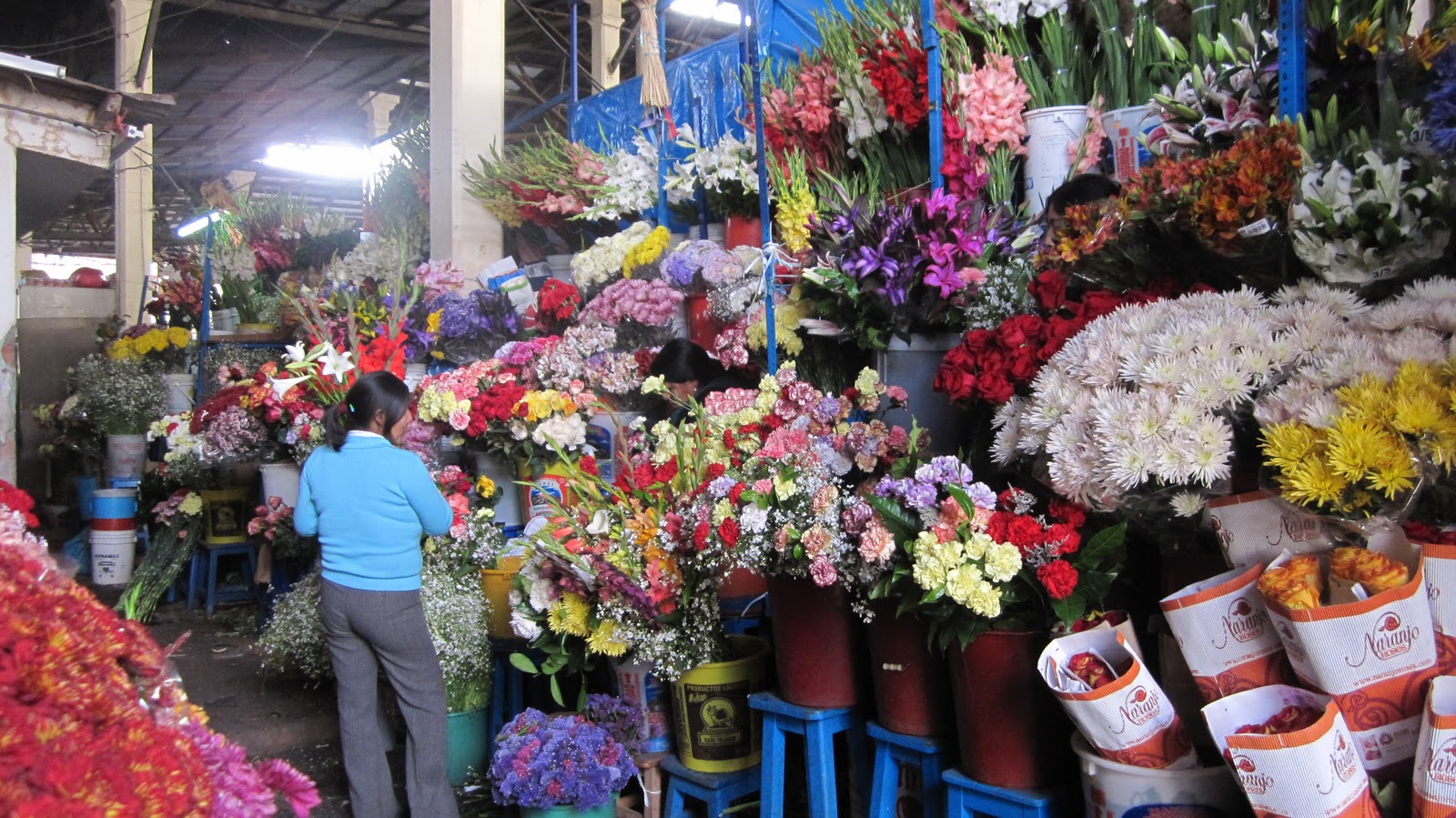
The old section of Cusco is a mixture of narrow cobblestone streets and wide paved boulevards and it feels like there is a large Spanish cathedral around every corner. There is also a smattering of Inca walls scattered about, most are part of some random colonial age building. West of the Plaza de Armas I found a huge open market where the locals go to buy fresh goods and most anything else you can think of including a whole section of fresh flowers. I love wandering through these markets. You will find every type of meat, just butchered hanging whole or cut into chunks and covered in flies; fruits and vegetables, some you can identify and some you have never seen before and anything else you can think of from grains to household items out for sale. This market also had numerous small stations with stools at counter tops that served some kind of soup with meat and vegetables., which is something I have not seen before at other open markets. Shortly after leaving the market the wind started gusting and I noticed the clouds building which had brought a little rain almost every afternoon for the last couple of days. I ducked into a church that was decorated with purple and white ribbon for the Senior del Milagros processions that were taking place that week. It looked like the church was getting ready for a service so I respectfully sat down to observe the people praying, lighting candles and altar boys scurrying about. It was a great place to be out of the weather and see the locals preparing for mass and the procession. After a short bit of rain I walked back toward the Plaza de Armas and wandered up and down some of the smaller streets that radiate out of from the square.

Not too far away is the chocolate museum with comfortable chairs and couches, similar to Starbucks, and you can order snacks and drinks. I went in and found a spot on a stool out on one of the small balconies that overlooked the Plaza Regocijo. It was a nice place to drink a coffee and watch the tourists and locals as they went about their lives below. If you ever go to Cusco don't miss the Chocolate Museum! They have a lot of interesting information about growing Cacao and making it into chocolate but my favorite was actually watching the process as they made their own chocolate right there in the museum. If you are used to the normal very sweet and creamy chocolate of the states then I should warn you that this will be bitter to your taste buds. I was great to try but not something I would eat on a regular basis. My American taste buds have been acclimatized to too much sugar. After a dinner of the most wonderful rotisserie chicken I went back to the hotel and packed to go home. This part of Peru is so full of history, I found it very interesting plus I had a lot of fun practicing my Spanish. Hopefully I will be invited back next year!