Thursday, May 3, 2012

Zanzibar

Just the name evokes thoughts of an exotic magical land of unknown whereabouts.  You have heard the name before but aren’t quite sure where it’s located.  Is it an island in the south pacific?  Or a city in India?  Maybe a town in Morocco?  Zanzibar is an island off the east coast of Tanzania in East Africa.  Combined with Tanganyika in 1964 to create Tanzania, Zanzibar Island is part of an ancient Arab and Portuguese trading route.  Known worldwide for spices and slaves; it was the location of the last legal slave market in the world and continues to be a producer of cloves, cinnamon and vanilla bean. 
I arrived on what felt like the hottest most humid day of the year.  The heat and humidity were oppressive and I climbed into a van that had been sitting in the sun with all the windows closed and had an A/C that felt like a very light, hot West Texas breeze.    That was the longest, hottest 60 to 70 minute ride of my life and to make it worse we were stopped three times by police at permanent road check stations.  Each time we were inspected by a very tall, very dark black man dressed in an all-white polyester uniform.  He carefully inspected all the different registration stickers on the car, looked in all the windows and then talked briefly to the driver before waving us on.  It was intimidating; if I were driving in a car by myself I would have been so nervous he would have assumed I was guilty of something.  Finally we turned onto what felt like a washed out river bed that led to a large metal gate, it was opened for us and we drove into a high porte-cochere with white plaster pillars and a very steep and tall thatch roof.  It opened to a lobby of the same style; welcome to the Ras Nungwi Beach Hotel located on the northern tip of Zanzibar Island.  The property is located on a white sugar sand beach laden with palm trees and fancy “grass huts” with thatched roofs, air-conditioning and lots of teak and mahogany furniture inside.  
Roof over the slave cave
Not far from Nungwi are the slave caves.  They are places where slaves were hidden during the illegal slave trade times between 1876 and 1907.  It was very emotional to see the “holding tanks” carved straight down into the ancient solid coral reef that makes up this island.  They were covered with concrete roofs and had very steep steps down into the two level caves.  There were very small openings toward the top but not sufficient to allow any air flow.  The heat was stifling with just two people standing down there.  I can’t imagine how stuffy, hot, sweaty, and stinky it would be with 50 or 60 people crammed in.  We then walked the trail used to scurry the slaves to the beach where boats were waiting in the dark of night.  The beach was so serene and beautiful that it was hard to imagine the evil that took place here.  I can’t begin to imagine the terror one would feel having been stolen from your home and family, stuffed into a cave, smuggled from the cave to a waiting ship, chained into the cargo hold where you vomited and defecated in place and then, if you survived the journey, you were auctioned off to a stranger for a life of hard labor.  How does one human do this to another?
On the way back to Stone Town we took a spice tour.  It’s a tour of a government owned farm with many different spices and fruits that are commercially grown by local farmers.  We saw clove trees, black pepper vines, a lipstick tree, chili peppers, a cotton tree, mango trees, banana trees, vanilla vines and jack fruit trees.  It was fascinating to see the tree or vine that grows the spices we buy in jars at the grocery store.


Stone Town, officially known as Zanzibar City, is exactly what you imagine; an old town with narrow stone streets that snake in and out without logic that are lined by two and three story stone buildings on each side.  You will find old palaces and homes of the sultans who ruled Zanzibar before the British arrived, one of the largest is a museum you can tour; The House of Wonders.  Near the center of the old town is an ornate Anglican Church that is located on the exact site where the last legal slave market in the world used to be.  The market was closed in 1873 and the church, construction started later that year, was specifically built on this site to help heal the evil of slavery.  Two of the slave storage chambers were kept as a reminder of how terrible conditions were. 
There was a large and small chamber, each only about three feet in height.  The large chamber held 75 slaves and the small chamber held 50 but they were terribly small spaces.  No slave could have stood; they would have had to sit with knees drawn up.  There was a trench down the middle that was used as a toilet and the ocean would wash it out at high tide.  Interspersed in the old Arab town are many colonial style buildings built when the British arrived in the late 1800’s.  Some evenings you will find a huge open market along the coast.  It is packed with people, both locals and tourists.  There are many individual stalls cooking and selling different types of food each with a small table and chairs so the patrons can sit and eat.  I saw a lot of seafood (shrimp, lobsters, and fish) plus chicken and mystery meat.  We joked about the mystery meat being cat.  I did not try any of the food that night and I wish I would have, there were a lot of things that were clearly cooked well and would have been safe to try.  I also took no photos and I am not sure why. 
Today Zanzibar is known for the export of fine raffia and seaweed but the tourist dollars are its main industry.  The newer parts of Zanzibar City are similar to every other third world city and not worth a visit but I recommend a visit to the beach, Stone Town and the forest area to the south where the colobus monkeys live.  If you go see the monkeys please send me photos, I was not able to get to that part of the island....yet.

Monday, April 30, 2012

The Safari Life

If only I could live every day on safari!!  In Swahili the word safari translates into English as journey.  I guess we all live every day on safari since every day is a journey through our lives.  But I would like to spend more time sleeping in a fancy tent with a comfortable cot , eating gourmet food cooked over a fire and cruising around in a Range Rover Defender looking for exotic animals.  Oh, just typing the words makes me nostalgic!! 
Before dawn a deep voice calls out “jambo, jambo” and wakes me out of a deep sleep.  Were those hyena calls and the sound of paws running through camp real or in my dreams?  Did I really hear the deep pulsing, cough-like roar of a lion last night?  I roll out of an army cot with a feather mattress and feather comforter onto a canvas floor.  I wash up from a wooden bowl with cold water, get dressed, put on a hat and go from my canvas tent across the camp to the large canvas dining tent.  Fresh hot coffee is waiting, most likely made with beans that were grown less than 20 miles away.  Breakfast is an assortment of hot and cold cereal, scrambled eggs, and toast with the most delicious mix fruit jelly. 

After breakfast I load up into the greatest vehicle ever; The Range Rover Defender.  It has been extended and upgraded specifically for safari companies, the bucket seats are cushy and very comfortable, each row of seats is slightly raised higher than the one in front so everyone has a great view and the roof pops up so you still have shade but can stand up and see 360 degrees.  Off we go, across the Serengeti or down the sides of the Ngorongoro Crater.  Everyone has their eyes peeled looking for the slightest bit of movement in the grass or on the high rocks of the kopjes.  Inevitability the ranger guide spots things first, his eyes are trained by hundreds of hours of looking for and observing animals.  He first spots two female lions lounging high up a few hundred yards away on the large kopje rocks.  We watch as they lounge in the morning light.  A bit later he catches just a glimpse of the cheetah’s dark tipped tail flicking just above the tall grass as she hunts something unseen to the rest of us.  We slowly get closer, he turns off the engine and all you hear are the clicks and whirs of digital cameras frantically taking photos.  Just up the road is a small group of zebras, slowly grazing, completely ignoring us as we drive near.  There is one very small youngster, whose stripes are still brown, standing next to mom, he looks at us, unsure of what we are, but mom is not nervous so he just watches us. 
Farther up the road is an enormous, wrinkled, gray elephant butt with a tiny flicking tail, walking down the road as if it is his personal highway.  He does not move aside and he is twice the size of the range rover so we happily follow without tailgating.  Eventually he turns left into the tall grass and meets up with a herd of females and juveniles of all ages who are standing along the edge of a small forest.  They all graze there without even giving us a second look.  We sit and watch as the two yearlings and a new born (maybe 2 months old) run in and out of the large tree-like legs of their mom and aunts.  The oldest female keeps a close eye on the big male but allows him to feed with her family.  After a while we drive on again, the scenery changes from wide open planes to a forest of fever trees with their eerie yellow bark.  We hear the loud chatter of vervet monkeys and laugh as they jump and play in the trees.  We are not there long because our guide sees something, none of us see anything.  He slowly coasts a few feet down the road and points into the tree, what is it?  I don’t see anything.  And then, I see the small twitch of a tail and realize it is attached to a huge leopard sleeping soundly, draped over a large branch high in the tree.   Now it is so obvious but seconds ago I saw nothing.  The large cat is muscular and beautiful, oh how I would love to give it a pat on the head and run my hand down its back like a house cat.  The cameras are clicking and whirring at each stop!  Before you know it we have been driving and watching for 3 hours so we head back to camp.  Back at camp, lunch is cooking, some people order a shower and the rest of us gather around the camp fire talking about the events of the morning.  We all take turns plugging our camera chargers into the cigarette lighters of the vehicles. 

Lunch is casual with sandwich fixings, and various hot dishes of pasta or meat.  I normally stick to drinking water because there is no ice in the bush and sodas are too warm to drink.  The cooks do have small refrigerators run by generators but space is precious so the sodas normally don’t get put inside.  I have found that it’s good to make friends with a cook or two because they will sometimes do you a favor and put a soda in the frig so it will be nice and cold for lunch.  After lunch there is time for a small rest and then it’s back out for the afternoon game drive.   We go a different direction this afternoon because our guide has heard there is a group of female lions snoozing right next to the road.  We race along bumpy dirt tracks and turn a corner to find 7 female lions sleeping just next to the road.  As we came to a stop, one female raised her head and looked at us as if to say, “Hey I am trying to sleep here!”  This was the closest we had been to lions so everyone in the rover was excited and snapping photo after photo.  We must have annoyed her because she stood up, stretched and ever so calmly jumped right onto the hood of the rover behind us.   She stood there looking into the windshield at the people in the rover.  The driver, a Meru man who was black as night, slowly stood up and gently pulled the roof closed.  All I could see was his dark face with huge white eyes as he closed the roof.  Those of us in the front rover were literally hanging out trying to get photos of this lady standing on the rover behind us.  Miss lion made herself comfortable on the warm hood and just sat there looking around as if she were a model posing for photos and board by our attention.  Then as quick as she jumped up, she jumped down and slowly wandered off across the plain followed by the rest of her group.  After that, the rest of the afternoon was almost unmemorable. 

Back at camp we sat around the campfire still excited about the lion encounter, each person telling what they thought and how they felt about our close encounter.  The kitchen staff served us fresh fire roasted peanuts and popcorn for an afternoon snack.  It is so relaxing to sit around a warm fire talking about what we saw that day.  Before dinner I would order a shower.  The shower consists of water boiled over a camp fire and then dumped into a bucket with a hose out the bottom.  The bucket is hoisted high above a canvas shower with a grated teak floor.  The hose out the bottom of the bucket leads to a metal shower head with a pull string; you pull and wet yourself down, let go, soap up, and pull again to rinse off.  It is so warm, smells like campfire and feels so good after a long hot day on safari.  Dinner was always a grand affair with many courses; a delicious creamy soup (different type every night), assorted meat dishes, potatoes cooked many ways, fresh veggies and fruit.   After dinner we retire back to the campfire to relax in canvas director chairs, hunt for the Southern Cross in the sky and wonder what we will find tomorrow.  The fire feels good and pretty soon my warm comfortable cot begins to call. 

After another night in the bush with the occasional hyena call, I get up and do it all over again.  You might think this would get boring but every single day brings something completely different; a new and different animal or an interesting behavior to watch.   SAFARI NJEMA RAFIKI! (Good Journey Friend)

Monday, November 7, 2011

Cusco, Peru


A call for volunteers went out from a group of American missionaries who needed help staffing a small carnival at their church as a way to make more contacts in the community. I received the request second hand and jumped at the chance. For me, the opportunity to volunteer doing something worthwhile is a great excuse to travel. I get the best of both worlds - the enjoyment of doing something good and the enjoyment of seeing more of the world. I arrived into Cusco on October 10, 2011 by train from Puno and went directly to the church where the kick off dinner was in progress. I had never met any of these people so it was a bit uncomfortable at first but introductions were made and things slowly warmed up. Out of the group of 17 Americans who had come to volunteer, 7 of us were staying in a hotel owned by friends of the missionaries. On Tuesday morning we walked to the church and spent the day organizing and decorating for the carnival. What started as a large empty room with a concrete floor became a large room filled with colorful flags, balloons and about 12 different booths with different games. It was an amazing transformation! For three days we had three sessions each day for children and their families to come play games, win small prizes and learn more about the church. It was physically exhausting but mentally encouraging.

After the carnival, most of my new friends left town right away so I moved to a hotel in old town. This would give me easy access to spend time exploring Cusco. Using Trip Advisor I found a hostal in an old colonial house that was priced well and located between Plaza de Armas and San Blas. It looked to be down a narrow alley or one way street and turned out to be a narrow alley that was up a steep set of stairs. It was a bit daunting to be at the bottom with luggage but one step at a time, clunk, clunk, clunk I pulled my wheeled suitcase up. I was breathing so hard that I could hardly talk when I got into the lobby. It was a small, old-world style lobby with large dark wood beams and wood floors that led to a small patio. My room was up a set of dark wood stairs that creaked with each step and led to a very long hallway that also creaked with each step. I opened the door to the cutest room with two twin beds, beam ceilings, ancient wood floors, a mural painted on the wall, and a small brick fireplace. There was also a large window overlooking a tile roof out to the city of Cusco. I felt like I had just checked into a small town inn back in colonial times with the exception of the modern bathroom. I love that old world feel but a modern bathroom is a must!!

After a good night sleep in a warm room with a comfortable bed I spent the next day on a guided tour of the Sacred Valley. I saw the quaint towns of Pisac, Ollantaytambo, and Chinchero along with many Inca ruins. It was a whirlwind tour with little time to really explore the towns. Note to self: spend a few days in the Sacred Valley not just one.  

Qorikancha
The next day was my last full day in Cusco so my game plan was to just explore, simply wander and see what I find that is not on the tourist map. I had only two must see places that day so I started with the ancient Inca site of Qorikancha (pronounced Cour-a-kancha). It was the most important temple in the Inca empire, dedicated to Inti, the Sun God. When the Spanish arrived in Cusco they wrote of the temple walls being covered in gold which the Inca took down in order to ransom their king from the Spanish. As was standard procedure for the Conquistadors, they tore down most the temple and built a cathedral upon the Inca foundations. It makes these sites an interesting mix of quality Inca stone work and colonial style buildings. Cusco has had two very large earthquakes, 1650 and 1950, that destroyed many colonial buildings but the Inca stone work is still standing as solid as the day they were built.

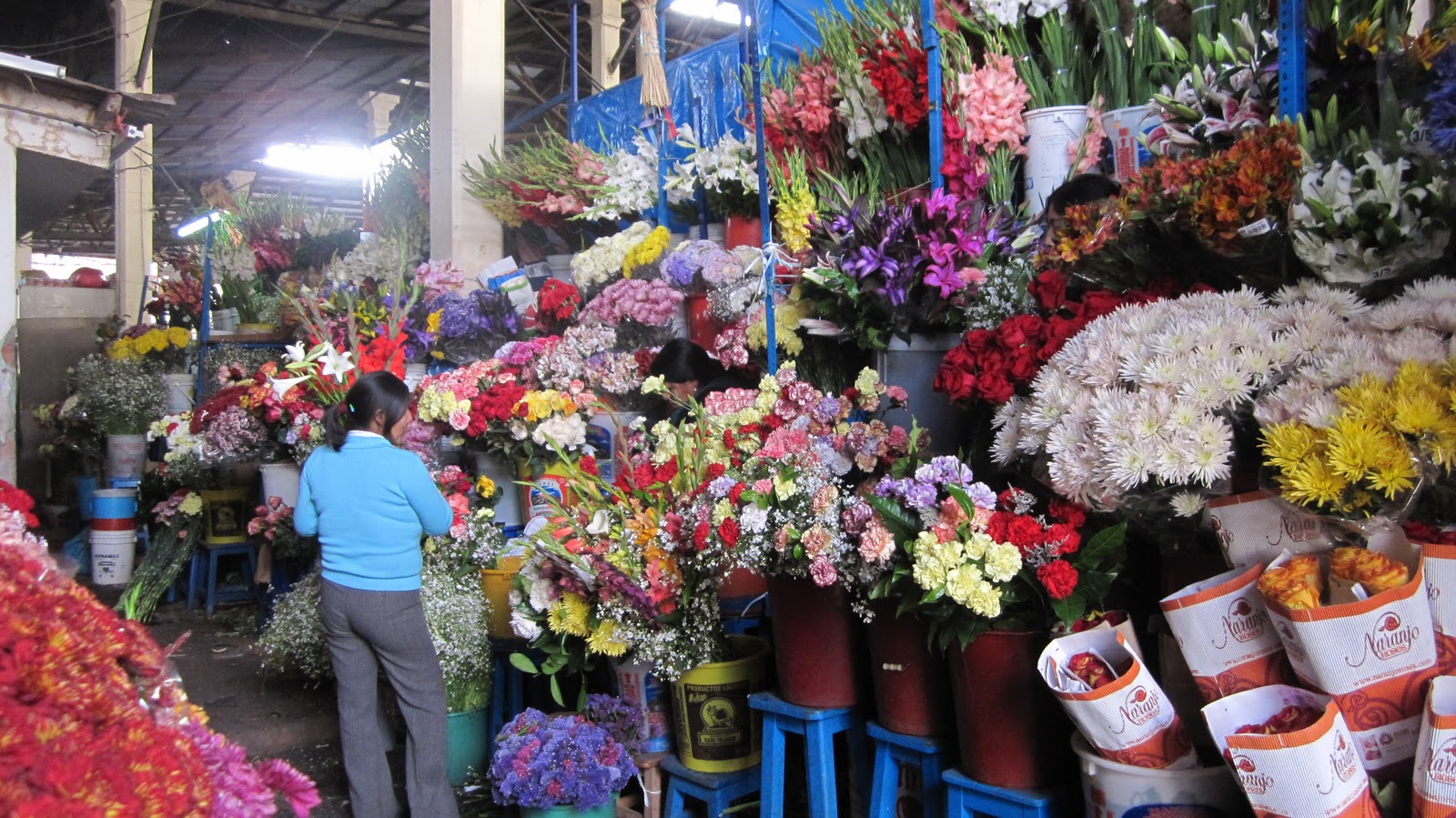
The old section of Cusco is a mixture of narrow cobblestone streets and wide paved boulevards and it feels like there is a large Spanish cathedral around every corner. There is also a smattering of Inca walls scattered about, most are part of some random colonial age building. West of the Plaza de Armas I found a huge open market where the locals go to buy fresh goods and most anything else you can think of including a whole section of fresh flowers. I love wandering through these markets. You will find every type of meat, just butchered hanging whole or cut into chunks and covered in flies; fruits and vegetables, some you can identify and some you have never seen before and anything else you can think of from grains to household items out for sale. This market also had numerous small stations with stools at counter tops that served some kind of soup with meat and vegetables., which is something I have not seen before at other open markets. Shortly after leaving the market the wind started gusting and I noticed the clouds building which had brought a little rain almost every afternoon for the last couple of days. I ducked into a church that was decorated with purple and white ribbon for the Senior del Milagros processions that were taking place that week. It looked like the church was getting ready for a service so I respectfully sat down to observe the people praying, lighting candles and altar boys scurrying about. It was a great place to be out of the weather and see the locals preparing for mass and the procession. After a short bit of rain I walked back toward the Plaza de Armas and wandered up and down some of the smaller streets that radiate out of from the square.

Not too far away is the chocolate museum with comfortable chairs and couches, similar to Starbucks, and you can order snacks and drinks. I went in and found a spot on a stool out on one of the small balconies that overlooked the Plaza Regocijo. It was a nice place to drink a coffee and watch the tourists and locals as they went about their lives below. If you ever go to Cusco don't miss the Chocolate Museum! They have a lot of interesting information about growing Cacao and making it into chocolate but my favorite was actually watching the process as they made their own chocolate right there in the museum. If you are used to the normal very sweet and creamy chocolate of the states then I should warn you that this will be bitter to your taste buds. I was great to try but not something I would eat on a regular basis. My American taste buds have been acclimatized to too much sugar. After a dinner of the most wonderful rotisserie chicken I went back to the hotel and packed to go home. This part of Peru is so full of history, I found it very interesting plus I had a lot of fun practicing my Spanish. Hopefully I will be invited back next year!

Monday, October 24, 2011

Machu Picchu

Just the name evokes a mythical dream of an ancient site in a far away land.  A place you have heard of but are not quite sure where it is or why it is so important.  For most travelers Machu Picchu is at least in the top 10 or 15 on the bucket list and not the easiest place to get to.  Built in the mid to late 1400's by the Inca it was most likely a royal retreat for the Inca ruler of the time, Pachacuti.  It is located between the Amazon jungle and the highland plains in Peru.  To get there is a bit reminiscent of the movie Planes, Trains, and Automobiles:  fly to Lima, fly to Cusco, bus to Ollantaytambo, train to Aguas Callientas, bus to the entrance of Machu Picchu.  It was all worth it the moment I set eyes on the site.

Our tour guide picked us up at 4:45 am at our hotel in Cusco.  We took a large tour bus to Ollantaytambo because we could get there quicker by bus than we could by train.  Beware that Peruvians are quite comfortable driving very fast around corners, passing on hills and their personal space comfort level is much closer than most Americans, which also translates into their personal space comfort level when it comes to other automobiles and pedestrians on the road.  If you are a nervous driver I suggest you sit in the middle of the bus on don't look out the window.  If you are easily car sick, take a Dramamine before you leave because the road from Cusco to Ollantaytambo is quite curvy up to a mountain pass and just as curvy as you go down into the Sacred Valley. 

Typical Machu Picchu Photo
After an hour and a half later we reached the quaint train station in Ollantaytambo and joined others headed to Aguas Callientas which is at the base of Machu Picchu and can only be reached by train.  The Vistadome Train is appropriately named for the windows high on the sides and roof of the train that allows you to see the soaring mountains as you traverse the valley floor next to the Urubamba River.  Every few feet were views that were so spectacular you wanted to take a photo knowing that no photo would ever come close to seeing the real thing.  In about two hours we came to the station at Aguas Calientas and got in the long line for the bus up to Machu Picchu.  The bus ride up the mountain was another hairy ride up switchback after switchback on a road with room for only one bus at a time, except we kept meeting buses coming down, face to face.  One bus would reverse into a small pull out the size of a footpath while the other bus would sneak by with only inches to spare on each side.  One inch to far either way and we were taking the mirrors off each bus or one wheel would be over the edge.  Every other switchback revealed a spectacular view down into the valley below getting smaller and smaller as we went up.  The bus let us off into a crowed of people, UGH!  At this point I was concerned this would turn into a day of some tourist filled spot with so many people that it would be over crowed and uncomfortable.  Once we are in the gate there is no place to use the bathroom so many of us thought it smart to go now.  Guess what??  It cost one sole to use the bathroom at Machu Picchu, yes this is only about 30 cents but it was funny to have to pay.  Also don't forget there is on toilet paper in each stall so bring your own or take some from the community dispenser at the entrance. 
Looking from bottom up to Guard House
I didn't realize that our group would have a tour guide so I had purchased a book, The Machu Picchu Guidebook, A Self-Guided Tour by Ruth Wright and Dr. Alfredo Valencia Zegarra, and was completely prepared to guide myself.  It would have been rude to take off from the group so I stuck with our guide using my book as much as possible.  Our guide started low on the ruins near the lower agricultural storage houses.  My very first impression of the site was exactly how steep the site is.  Think about that standard MP photo that everyone sees, like the one above.  It looks relatively flat, yes it is on top of a mountain, yes you see stairs but it does not seem to be so steep that it can't be easily walked.  Well let me tell you this is quite deceiving.  The photo is taken from the guard house looking down but when you are at the bottom looking up it is very intimidating how steep it really is.  The next photo, to the right, is from the lower section looking up to the guard house and you can get an idea of how high it is when you see how small the people in the photo are.  When you are at the bottom looking at stairs that are 18 to 24 inches each step that seem to go straight up and you are at over 8000 feet when your little lungs are used to living at sea level you might be tempted to think there is no way I can do this.  Let me tell you that you can do it!!  Our tour never made it to the main entrance and the guard house and I was determined to see both these places and to take the standard MP photo.  When the tour was over I went straight up the stairs taking them one at time not looking up and not stopping until my heart was about to pound right out of my chest.  I took a small break and started again.  I made it!!  There were a lot of people standing in line to get their photo taken at the main entrance so I just took a couple of photos and went on to continue to climb to the guard house.  The open field next to the guard house is where the typical MP photo you see in all the books is taken from.  I took a few photos and then got out my phone to take on of me with MP in the background. 

Machu Picchu Main Gate
Our group had to meet back at a restaurante in Aguas Calientas around 2 for lunch so from the guard house I had to walk down the path back to the main entrance to catch the bus back.  My legs were like spagatti and my knees were really hurting.  It began to sprinkle but it felt good so I did not bother with the rain coat I had been carrying all day in my back pack.  After lunch I walked around the market next to the train station and was limping like an old woman becuase my legs and knees hurt so bad.  It was all worth it and I would have been perfectly happy to go back and do it again the next day.  The Inca were a facinating civilization and there is so much to see at MP that you would not easily know without some research before, even a guide will not have time to point out some of the more subtle items like the torch holders, holes used to bar the door, an example of how they carved the corners so percice and many other things.  If you are going on your own, I highly reccomend the above book, it gave me a game plan to see the whole site in an organized way. 

The trip home was exactly like the trip there in reverse execpt I actually slept and we arrived back to the hotel about 9:30. 


MACHU PICCHU SUGGESTIONS AND WHAT I WOULD DO DIFFERENTLY:

Make sure you have water, sun screen, bug spray and a rain poncho, take snacks.  Do not go down the mountain to eat lunch in Aguas, bring a sandwich or something with you.  Find a nice spot with a spectacular view (they are all around) and enjoy lunch soaking in the scenery.  Wear shoes with good strong soles, there are a lot of rocks and I was glad to be wearing my hiking boots instead of tennis shoes but many in my group did have tennis shoes and seemed to do fine.  Bring your Advil, Tylenol or what ever you like.  If you are more than 30 your legs will be tired and achy and you don't want to let any pain get in your way of enjoying this once in a lifetime spot. 

The next time I go (I hope there is a next time becuase it is worth doing again), I will take the afternoon train to Aguas and stay there at least two nights.  I will get up early in the morning and take the first bus up the mountain so that I arrive before all the "train tourists" fill the place up.  I will either have a sandwich with me or I will pay the price to eat at the Sanctuary Lodge located at the front gate.  I think the sandwich and snacks might be the better way to go because I can find an out of the way spot to sit, eat and enjoy the atmoshpere.  I will spend as much time up at the site as possible, slowly making my way around the site with my guide book at my own pace, reading about each location and just soaking in the majesty of the ruins and the mountain top location. 

Tuesday, October 18, 2011

Train from Puno to Cusco, Peru

Early on Monday morning I boarded the train in Puno, Peru (near Lake Titicaca), bound for Cusco, Peru. It was a lot more elegant than I expected. Wingback chairs, a table with a nice cloth cover, a lamp on the table and a waitresses to bring food and drinks. I watched the countryside pass by while almost every child waived at the train. In one town the train tracks pass through an open market that offered anything a person could need from kitchen supplies to car parts. The train passed only inches from the booths while many vendors quickly removed their goods from the track only to return them as soon as the train passed. Some venders had smartly placed their goods between the rails low enough for the train to pass right over.

I am pretty sure I was the only American on the train. A nice couple next to me was Australian, they had been to Argentina and Brazil before coming to Peru. I also heard French, Portuguese, and Spanish being spoken on my car.

Through the bar car to the back of the train was an open car where I could stand and feel the warm air while watching the tracks as the train left them behind. It was a great place to watch people in the countryside as they went about their daily lives. Some were working in fields getting them ready to plant, others were tending sheep or cows as they grazed. The animals were tied to a stake in the ground so they could graze a circular area and I am guessing they were moved to different locations every day. Sometimes local dogs would chase and bark at the train getting scary close to the wheels. People in the cities were always waiting at crossings for the train to pass so they could go about their daily lives. In the cities most people ignored the train but many people in the country stopped and looked and often waived.

I was never board! A nice lunch was served at noon with our choice of soup, main dish and dessert. The train stopped once at a small trackside market that seemed to be in the middle of nowhere. There were two different bands playing Peruvian music with dancers, plus a fashion show plus tea and sandwiches were served about four. We pulled into Cusco about 6 pm just as it got dark.

It was a nice thing to do once but was expensive even for all the entertainment and good food. I think I will take the bus next time.

Sunday, October 9, 2011

Lake Titicaca

Arrived Puno, Peru yesterday after a night in Lima. Puno is located in southern Peru on Lake Titicaca at 13,000 feet. That is a big jump for a girl who lives at sea level. I had a headache all day long. I spent most of my time sitting in a cafe overlooking the central square, Plaza de Armas, drinking coca tea. Yes it is made with leaves from the coca bush, the same leaves that are used to make cocaine. There is less than one percent of the ingredient used to make cocaine in each leaf so it does not make you high. In fact it takes hundreds of grams of cooked down coca leaves to make any amount of the drug. Coca leaves are very important to the Peruvian people, they do not use it as a drug, it is more of a health product. It is very affective against altitude sickness and the headache that comes with it.

I had a nice Saturday afternoon just watching the local people in the square. Later I attended mass in the large Cathedral. I am not catholic but I wanted to experience church in one if those wonderfully old, large, cold, stone churches that makes me feel reverent just walking in the door.

Today was the tour of the lake. I joined a group tour on a boat that took us to the floating islands of Uros and the larger island of Taquile. Surprisingly I was the only American. There were lots of Brits, some French, one Italian and a Polish couple.

The floating islands of Uros are literally that, islands made of reeds that float in the lake. These people live here year round in small reed homes, they fish, hunt birds and ducks, collect bird and duck eggs and even grow some small vegetables. They also trade these things with people on the mainland for other goods they need. In the attached photo you can see a small cross-section of the island they use for demonstration. Then they anchor the island to the lake bottom so it does not float away to Bolivia. They regularly refresh the top layer of reeds which eventually composts into the material you see in the photo.

Of course they sell many goods made from reed or wool, there are many sheep on the mainland. They also sell rides in the reed boats. We were told up front how much it costs but I was amused when he collected the money half way into the ride. As if to say, pay or swim back. The water us about 50 degrees so no one wanted to swim.

The island of Tequile is a large island located 2 1/2 hours boat ride from Puno and it is not even 1/4 across the lake. The people there are very traditional in dress and culture and are known around the world for their weaving and knitting. The men knit and the women weave. They have terraced the entire island for farming and raising sheep and cows. To get to the village we walked a trail that gained at lease 500 feet in less than a mile, not so easy at over 13,000 feet for a girl from sea level. We walked up one side of the island, explored the village, had lunch, and walked down over 500 steps on the other side of the island. It was work but so worth it. Most of my good photos are in my camera so I will post them later.

Tuesday, September 27, 2011

Mid-life Crisis Travel

A few years ago I was 39, divorced, my dog had died, and I had not yet started the busy travel schedule that I now love.  Needless to say I was just a bit depressed.  I was the one guest of a self-pity party, held in the privacy of my own home.  I had been thinking about getting away, taking some great trip.  Why not start at the top of the bucket list?  What would be the first item on the list?  For me there was no doubt that would be an African safari. The problem is that Africa is a huge continent with so many great safari locations, so the hard part was where and with whom?  For the last couple of years I had been half hardly researching locations and companies; it gave me something to do and made me feel better just to think maybe. 
On a particularly lonely Thanksgiving holiday I decided to “JUST DO IT” so I picked up the Thompson Safari catalog for 2007 to see what they had around my birthday.   Their classic safari was timed perfectly and also included some of the great wonders of the world: The Serengeti Plains, Ngorongoro Crater and Olduvi George.   I also added the Zanzibar extension.  If I am going to fly half way around the world I better make it worth it and see all I can.  Just the name Zanzibar evokes dreams of exotic travel in old colonial locations, where people actually sit on a veranda carved from exotic tropical woods with fans slowly turning above as they drink something cold with mint leaves while looking out on an old stone town with narrow streets, surrounded by palm trees that filter views of a sparkling blue ocean.  I called Thompson to see if they had space on this tour that was less than four months away and they did.  Normally they were booked nine or ten months in advance so this must be a sign.  Right?  I called my Dad because this is always something he has wanted to do also and told him I was doing this, he and Mom were welcome to come but not to worry I was going no matter what.  He hung up, talked to Mom and called me back in less than an hour to say they were in.  I wonder if that conversation went something like this, “Karen is going on safari and I have always wanted to do that too, so how about going with her?”  Or if it was more like this, “Karen is going on safari and there is no way I want her gallivanting around Africa by herself so we are going too.”  Either way, they went with me and it was nice to have them along. 
I spent many days reading over my National Audubon Society Field Guide of African Animals and at least a month piling up items on my coffee table that I did not want to forget.  We were only allowed one soft sided duffel bag that weighted no more than 33 pounds so planning the right wardrobe was quite difficult.  After packing, weighing, packing, and weighing again I was ready to go!  I flew direct from Seattle to Amsterdam where I met up with my parents and the three of us flew from Amsterdam direct to Kilimanjaro International Airport.  KIA is located in between Moshi and Arusha in northern Tanzania and is just at the foot of the great Kilimanjaro, the roof of Africa, the highest mountain in all of Africa.  I was excited to get to see this legendary mountain, but we arrived in the dark and immediately drove west and were so far from it the rest of the trip that I never did see it.  I flew 10,000 miles and never saw the greatest mountain in Africa. 
I walked from the plane onto the roll up stairway and I was greeted by a warm African night and the most wonderful sweet smell that turned out to be a mixture of blooming trees and burning wood.  I felt like I was coming home to a place I had never been! 
If I write one blog post on the entire trip you will be reading for days, or sound asleep in minutes, so I will break this up into the different locations that we visited…more to come…